Gyeongju: everything YouTube's best creators show you — sorted
21 videos across 4 topics, ranked by what's actually worth your time.
Gyeongju is where South Korea’s standard itinerary shifts gear. Most first-timers bolt from Busan back to Seoul without stopping, which is the wrong call — this city was the Silla Kingdom’s capital for nearly a thousand years, and the density of what remains is unlike anywhere else on the peninsula. The case for two nights here is straightforward: it slots neatly into a 10-day South Korea trip and rewards the detour with material you simply cannot find in Seoul.

The city’s sights cluster into three zones, and the distances between them are what the Purple Line tram was built to solve. Hop on Purple Line number four at Tong Moon history and culture Park station and ride it outward to cover the main historical belt — a practical routing tip that most guidebooks omit entirely in favour of vague advice about hiring a driver.
The core zone around the old centre holds pagodas, stone bridges, and formal gardens that the “10 Days in South Korea” video frames methodically, site by site. Note that these are not reconstruction projects — the scale of what survived is genuinely unusual. The mountain fringe is where Seokguram sits: an ancient Buddhist cave temple perched above the city, reached by a walk through forested slope rather than a car park.
The Yundong neighbourhood deserves its own mention. It is the part of Gyeongju that changes depending on what time of day you arrive — usable for dinner in the evening and for café-hopping later on, popular with both locals and visitors. That dual timing makes it a useful evening anchor when you are done with the historical circuit. Importantly, Yundong is not the historical zone — it functions more like a small urban quarter bolted onto a heritage city, and the tonal shift is abrupt in a way that can surprise travellers expecting consistency.
The consensus from multi-city itinerary creators is that Gyeongju works best outside peak summer — the open-air sites lose their appeal fast in July and August heat, while spring and autumn give you manageable temperatures for walking the historical belt. The “South Korea Itinerary: 7” video slots Gyeongju into a 10-day structure, which implies a 2-night stay as the working minimum; one night is widely considered not enough.
On food, Hong Nam Bread is the item most consistently flagged — it is a Gyeongju-specific sweet bread with a local following that the “10 Days in South Korea” creator singles out by name. Beyond that, the same video points to Yundong’s restaurant concentration for evening meals. The honest picture is that Gyeongju is not a food city the way Busan or Jeonju are — the eating here is solid Korean provincial cooking rather than a destination food culture. The catch is that this is actually an argument for shorter stays: two nights lets you eat well without exhausting the options.
Two nights is the working consensus. The historical circuit and Seokguram together account for most of a full day; Yundong and any time at the tram stations fill the second. Skip the impulse to extend to three nights unless you have a specific reason — the city is compact enough that a third day will feel padded.
The “10 Days in South Korea | Sydtravella” video is the most structured of the available Gyeongju sources: it runs through sites in sequence with accommodation tiers (Hilton Gyongju for comfort, Gyongju Guest House for budget) and flags Hong Nam Bread as a food stop, making it the right video to watch first as a planning skeleton. The “2v8uecv5LEQ” video then fills in the transit logic — specifically the Purple Line routing — that Sydtravella leaves underdeveloped. Pair them in that order: Sydtravella for the what, the Purple Line video for the how-to-move-between-it. Together they cover the ground neither does alone.

Architecture
All 3 architecture videos →
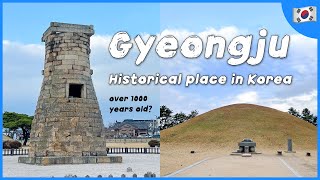
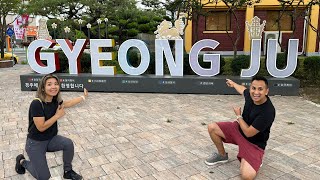
Day Trips
All 4 day trips videos →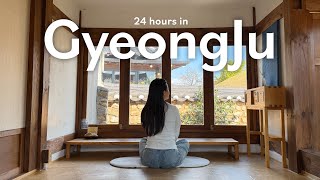
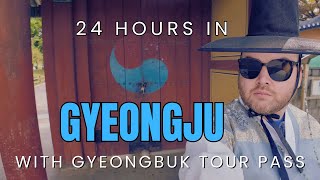
Temples
All 10 temples videos →![Top 10 Best Things to do in Gyeongju, South Korea [Gyeongju Travel Guide 2026]](https://img.youtube.com/vi/Ozg-lqtxuIA/mqdefault.jpg)
Traditional Culture
All 4 traditional culture videos →
![[Korean Culture]Gyeongju, the City of a Thousand-year-old Promise EN](https://img.youtube.com/vi/cYiWvZBJC6k/mqdefault.jpg)
Other cities in South Korea
Turn these videos into a Gyeongju day-by-day plan.
Plan my days in Gyeongju →