Chiang Mai: everything YouTube's best creators show you — sorted
27 videos across 6 topics, ranked by what's actually worth your time.
Chiang Mai is the north’s counter-argument to Bangkok: slower, cheaper, and with a food culture so distinct it warrants a separate taxonomy from the rest of the country. The old city walls concentrate temples, cooking schools, and weekend markets within walking range of one another, while the surrounding mountains supply the day trips. The proposition is three to four days minimum — long enough to eat your way through the northern canon without rushing any of it.

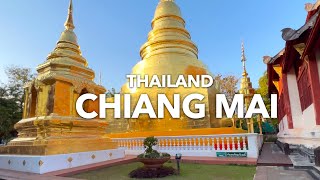
The old town sits inside a square moat and holds the densest cluster of temples in northern Thailand. Wat Phra Singh is the most-visited and free to enter; Wat Chedi Luang, where the Emerald Buddha resided before Bangkok claimed it, charges 40 baht. The all-teak Wat Inthakin Saduak Wang is also free and draws far thinner crowds — the standard route of only hitting the moated temples misses it entirely.
Outside the walls, Nimmanhaemin Road runs northwest and is the city’s cafe-and-boutique corridor. Songthaews — shared red pickup trucks — are the practical way to reach anything beyond walking distance, and a ride to Doi Suthep temple on the hill above the city takes 30 to 40 minutes.
The Sunday Night Walking Market on Wualai Road runs along the old silversmithing district and offers a noticeably more local crowd and slower pace than the Night Bazaar on Chong Klan Road. The Night Bazaar is louder, more commercial, and better suited to street food grazing than shopping. If the choice is one, the Sunday market sets the correct frame for the city; the Night Bazaar feeds you well.
For a day out of the city, the area around Chiang Mai offers elephant sanctuaries, zip lines, and jungle treks — creators converge on booking these early as slots fill.
November through February is the consensus window: cool enough in the evenings, dry, and the period when the Sunday walking market draws its biggest crowds. Avoid March and April if smoke from agricultural burning is a concern; several creators flag this as a genuine air-quality issue rather than a minor inconvenience.
Northern Thai food is categorically different from what most visitors ate in Bangkok. Khao soi — egg noodles in a coconut-curry broth, topped with crispy fried noodles, fermented mustard greens, and a squeeze of lime — is the dish that defines the region. Sai ua, a pork-and-lemongrass herbal sausage grilled over charcoal, appears at almost every night market stall and repays attention. Nam prik ong, a tomato-and-minced-pork chilli dip served with sticky rice, is quieter than khao soi but equally representative.
For budget meals, the old town near the moat has several cheap-eat options that creators have rated well without pointing to a single dominant venue. For a fuller restaurant sit-down, the video covering restaurants for all budgets names a place down a lane called Rottan Road as its top pick — worth consulting before planning the first dinner. Sticky rice eaten with the fingers alongside charcoal-grilled meats at a street stall is, one creator argues, the best distillation of the Chiang Mai experience.
Three nights is the floor; four gives breathing room for a day trip to Doi Suthep and still leaves an evening for the Sunday market. Skip the temptation to base yourself outside the old town on a first visit — the moat-adjacent streets concentrate the majority of temple, market, and food activity, and the time saved by staying inside the walls is real.
The “I Went Looking for Street Food” video maps five distinct markets across the city with travel time between each — useful as a single-session planning tool if you have one evening and want coverage rather than depth. Pair it with the Night Market compilation, which covers the Night Bazaar and Sunday walking market in detail, to understand which dishes recur across both settings and are therefore worth prioritising. Together they cover the market landscape more completely than either does alone.
The videos below do not dwell on temples — food and market footage dominates the corpus. Treat any temple itineraries as orientation and the food footage as the actual substance of the curation.
Cuisine
All 6 cuisine videos →
Day Trips
All 2 day trips videos →

Itinerary
All 1 itinerary videos →
Nature
All 2 nature videos →
Temples
All 12 temples videos →


Traditional Culture
All 4 traditional culture videos →
Other cities in Thailand
Turn these videos into a Chiang Mai day-by-day plan.
Plan my days in Chiang Mai →