Rome: everything YouTube's best creators show you — sorted
45 videos across 7 topics, ranked by what's actually worth your time.
Rome operates on a longer time-horizon than most cities — two millennia of accumulated decision-making are still legible in the street plan, the food, and the rhythms of daily life. The practical consequence is that three days here barely scratches the surface, yet most visitors still spend half of them in queues at the Colosseum. The creators in this set collectively make the case for a different allocation: anchor in Trastevere, ration the mega-monuments, and spend the surplus hours eating well.

The city divides into a handful of distinct operating zones, and where you base yourself determines how much you pay in transit time each day. The historic centre — Piazza Navona, the Pantheon, Campo de’ Fiori — is the obvious hub, but creators converge on Trastevere as the better residential choice: a 15–30 minute walk to nearly every landmark, and the food quality steps up noticeably the moment you cross the Tiber.
Monti, east of the Colosseum near Termini, is a second area worth noting. One creator identifies it as a “trendy, up-and-coming” quarter whose proximity to the main rail station makes it a practical option for shorter stays. It also hosts Mizio Street Food, a small-format sandwich counter that several creators single out as a reliable lunch stop without the tourist premium.
The standard monument circuit — Colosseum, Pantheon, Trevi Fountain, St Peter’s Basilica — is well-documented and worth doing, but Piazza Navona rewards a longer pause than most itineraries allow. It is an unusually long oval, easy to photograph and leave quickly, but a late-morning hour there with a coffee produces a different quality of encounter. The Pantheon, now housing burials of artists and former Italian kings, remains the world’s largest unreinforced concrete dome — a fact that reframes the visit from “another old building” to something considerably more specific.
Creators converge on the early-morning advantage: being at major sights before the day’s crowds arrive produces a qualitatively different experience, and the light in those hours rewards photography [via Planning Italy Here’s]. April–May and September–October are the most amenable windows, avoiding both the January chill and the August heat that empties the city of its residents.
Rome’s food identity differs from the rest of Italy’s in ways that matter to planning. Pizza here is served whole to one person rather than shared, and asking for mozzarella di bufala is worth the habit [via Visit Rome What]. The Trastevere morning market at Piazza San Cosimato, open Monday through Saturday from 6 a.m. to 1:30 p.m., is the practical entry point for vegetables, cheeses, and a nearby coffee stop. The “15 Foods in Rome” video is the densest single resource on Roman food specifics: it works through prosciutto and mortadella antipasti, handmade pasta, and pizza variations including zucchini flower and artichoke toppings. For street eating, Roman-style pizza sold by the slice at bakeries — distinct from Neapolitan pizza — is the cheap local workaround that creators who’ve spent time here return to consistently. Skip the restaurants immediately flanking tourist landmarks; one creator notes that a two-minute detour to a side street will cut prices and lift quality without sacrificing convenience.
Three days is the consensus floor for Rome done properly, and the “How to visit Rome” three-day itinerary is the most structured version of this: it sequences ancient Rome first, then the baroque centre, then Trastevere in the evenings, so each day builds on the previous one rather than fragmenting across the map. That video is worth watching before you arrive purely for the sequencing logic — it is light on food specifics but strong on pacing.
The position worth taking explicitly: skip the Vatican on a short trip if your priority is food and neighbourhood texture. One creator mentions an attraction they “kind of wish” they had skipped without naming it, and the Vatican — which generates the longest queues in the city — is the obvious candidate. The time cost is substantial, and the payoff is high only if Renaissance art is the priority.
Pair “My 10 Favorite Things” Trastevere deep-dive with “The Best Things To Do In Rome” overview: the former gives granular neighbourhood knowledge including the morning market and specific piazzas, the latter frames how Trastevere sits within the whole city — together they resolve the base-versus-tour question that single videos leave open. The videos below extend this logic across food, monuments, and neighbourhood texture that no single itinerary can compress.

Architecture
All 12 architecture videos →

Budget Tips
All 5 budget tips videos →
Cuisine
All 7 cuisine videos →
Day Trips
All 5 day trips videos →![10 Easy Day Trips from Rome by Train (No Car Needed) [4K]](https://img.youtube.com/vi/IYsfQo2218k/mqdefault.jpg)
Hidden Gems
All 4 hidden gems videos →![10 Hidden Gems in Rome Most Tourists Miss (No Crowds) [4K]](https://img.youtube.com/vi/fyKOPhYaJ5c/mqdefault.jpg)

Itinerary
All 6 itinerary videos →
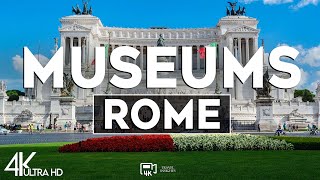
Museums
All 6 museums videos →

Other cities in Italy
Turn these videos into a Rome day-by-day plan.
Plan my days in Rome →