Mount Nemrut: everything YouTube's best creators show you — sorted
19 videos across 3 topics, ranked by what's actually worth your time.
Mount Nemrut is not a city — it is a single, extraordinary purpose: a 2,150-metre summit in southeastern Turkey where a first-century BCE Armenian-influenced king built a funerary sanctuary and ringed it with colossal stone heads of ancient Greek, Persian, and Armenian gods. The UNESCO World Heritage designation preserves the site, but what draws travellers is simpler — watching those heads glow during a 20-minute sunrise or sunset window at the top.

The summit holds two terraces — east and west — each lined with seated limestone statues of deities including Zeus-Ahura Mazda, Apollo-Mithras, and Tyche, plus lion and eagle guardians. The heads, which toppled from the bodies centuries ago, are arranged in rows and reach roughly two metres tall; the effect is closer to Easter Island than a conventional ruin, though set at altitude rather than coastline.
The surrounding region, Adıyaman province, provides the logistical base. Adıyaman city and the smaller town of Kâhta are the standard overnight stops, and both sit within roughly 70 kilometres of the summit road. The standard route involves either a guided minibus up a switchback road or a hike along a marked but steep trail from the lower car park.
Note that the site itself is compact — you can walk both terraces within two hours. The value is entirely in the light conditions and the statues, so the surrounding landscape, though dramatic, is secondary. Creators who skip Adıyaman city and travel directly to Kâhta report a more efficient visit, particularly for single-day trips from Gaziantep or Şanlıurfa.
The consensus across creators is late spring (May–June) or early autumn (September–October) for the summit visit. Summer brings intense heat on the ascent and afternoon haze that washes out the golden-hour light; winter closes the summit road intermittently with snow. The operative window at the top is narrow — roughly 20 minutes around sunrise or sunset when the low-angle light cuts across the stone faces — so timing the drive or hike to arrive 30 minutes early is essential.
Food at the summit is minimal — a small café operates near the car park in season, but no sit-down dining exists at altitude. Kâhta and Adıyaman carry the food story. The regional cuisine of southeastern Turkey leans heavily on slow-cooked lamb, bulgur pilafs, and lahmacun; one creator notes that Adıyaman is specifically associated with a thin, crisp variant of lahmacun distinct from the western-Turkish version. For a post-summit meal, the guesthouses in Kâhta typically serve a set dinner that functions as a reliable, unfussy option after an early-morning start.
Most visitors allocate one night in Kâhta and one summit visit, and that is correct. Stretching to two nights adds little unless you plan to combine the Nemrut visit with the nearby Arsameia ruins or the Cendere Roman bridge, both of which are within 30 kilometres of Kâhta. The “full-day Nemrut tour” sold by operators in Adıyaman city pads the schedule with stops that add time without adding value — skip it and arrange a direct transfer to Kâhta instead.
The “Amazing Places to Visit in Turkey” video places Nemrut in a broader country list and is useful for benchmarking the site against Cappadocia or Pamukkale — watch it first to calibrate whether the eastern Anatolia detour fits your itinerary. The “50 Things to do in TÜRKİYE” video gives a tighter characterisation of the summit experience — specifically the sunrise framing and the comparison with nearby Ani ruins — and is the better single reference for planning the summit logistics. Pair the two: the former sets the geographic context, the latter converts it into a practical morning plan.

Day Trips
All 5 day trips videos →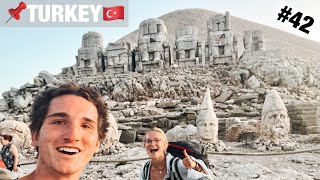
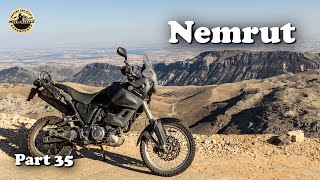
![TURKEY VAN LIFE PROBLEM Visiting Gobekli Tepe & Mount Nemrut [S6-E170]](https://img.youtube.com/vi/_QFi9MOStFs/mqdefault.jpg)
![[S1 - Eps. 106] A SURPRISE VISIT TO MOUNT NEMRUT, TURKEY](https://img.youtube.com/vi/wyLxPljQWOY/mqdefault.jpg)
Hidden Gems
All 3 hidden gems videos →
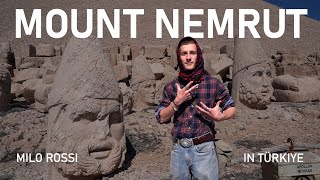
Nature
All 11 nature videos →

Other cities in Turkey
Turn these videos into a Mount Nemrut day-by-day plan.
Plan my days in Mount Nemrut →