Pamukkale: everything YouTube's best creators show you — sorted
22 videos across 3 topics, ranked by what's actually worth your time.
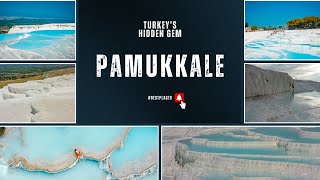
Pamukkale’s proposition is unusually legible: a hillside of calcium-rich thermal water that has built up white travertine terraces over millennia, sitting directly above the ruins of the ancient spa city of Hierapolis. The combination means you spend one afternoon wading barefoot through pools that are genuinely warm, and the next morning walking through a Roman theatre, necropolis, and a set of baths whose original purpose was identical to yours. That clarity of purpose makes Pamukkale one of the few single-day stops in Turkey that feels properly earned rather than tick-boxed.

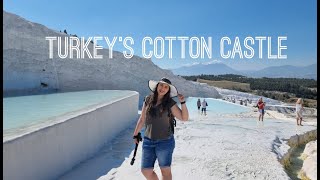
The terraces themselves are the centrepiece. Calcium-rich thermal water flows continuously down the hillside, forming the shallow white pools that read, from a distance, like freshly fallen snow. The terraces can be slippery in places — several creators flag this specifically — so bare feet and slow movement are standard. Shoes are collected at the base before you ascend.
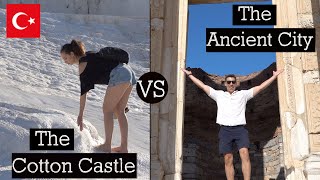
Above the terraces sits Hierapolis, an extensive ancient city whose ruins include a Grand Theatre, ancient baths, and one of the largest necropolises in Anatolia. The ruins sprawl along an adjacent hilltop, so factor at least a half-day to walk the full site rather than just the photogenic columns near the entrance. Cleopatra’s Pool — a thermal spring where fragments of ancient columns lie on the floor beneath the water — sits at the edge of the ruins and is consistently flagged as worth the separate entry fee.
Importantly, Pamukkale works well as a base for a cluster of less-visited ancient sites: Laodicea, Tripolis, and particularly Afrodisias, described as a gorgeously preserved Roman city with an impressive collection of marble sculptures. None of those three appear in most standard itineraries, which makes them a strong argument for a second night.
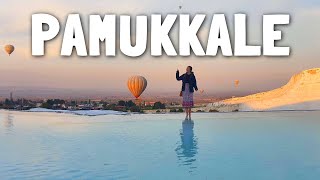
The standard creator consensus places Pamukkale in a broader western Anatolia swing — typically following Cappadocia and preceding a move to the Turkish Riviera. What this means practically is that mid-spring and early autumn are the preferred windows: the terraces are less crowded and daytime temperatures are manageable for the exposed hilltop walk. Multiple itinerary videos route through at sunset, which one creator notes produces the best photographs of the terraces, when the white calcium picks up orange and pink tones.
Food options near the terraces are modest. Source chunks put meals in local cafes at 100 to 300 Turkish lira, described as simple local dishes rather than a destination food scene. The one dish with specific grounding is kashke — a slow-cooked wheat and tender meat preparation described as a traditional Anatolian staple, well-suited after a morning on the hillside. Hotel prices in the area range from 1,000 to 3,000 Turkish lira per night, with options sitting in and around the town below the terraces. The town itself is small; the resorts and spa hotels outside the main terraced area offer access to thermal pools without the crowds of the public site.
Two nights is the practical minimum if you intend to visit Hierapolis properly and make a half-day trip to Afrodisias. One night — the default in most itineraries — is enough to see the terraces and a surface-level pass of the ruins, but not much more. Skip the itineraries that bundle Pamukkale into a single rushed stop on the way from Cappadocia to Antalya; that pattern leaves you on the terraces for ninety minutes and the ruins for thirty, which undersells both.
The “TURKEY — One Country That Feels Like Five” video is the most focused Pamukkale treatment in the curated set — it covers the terraces, Hierapolis, and the practical logistics (slippery surfaces, food costs, accommodation range) in a single tight sequence, making it the right starting video if you have limited time. Pair it with the “TURKEY in 7 Days” video, which goes further on the food side — including kashke — and frames the stop within a full western Anatolia sweep from Ephesus through Pamukkale to the coast. Together, the two cover what the terraces actually feel like to walk, what the ruins offer beyond the standard photographs, and how the stop fits into a wider Turkish itinerary.
Day Trips
All 5 day trips videos →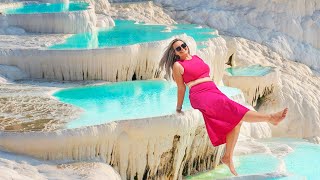
Hidden Gems
All 7 hidden gems videos →



Nature
All 10 nature videos →
Other cities in Turkey
Turn these videos into a Pamukkale day-by-day plan.
Plan my days in Pamukkale →