Salvador: everything YouTube's best creators show you — sorted
30 videos across 4 topics, ranked by what's actually worth your time.
Salvador is the argument against treating Brazil as a Rio-or-bust itinerary. The city is the largest Afro-Brazilian cultural centre in the country, and its Pelourinho district — cobblestone streets, colonial facades, live samba echoing off the squares — is a UNESCO World Heritage site that earns the designation. What makes it worth the diversion is the density: Candomblé, capoeira, acarajé stalls, and Baroque churches all within walking distance of one another.

The Pelourinho is the logical starting point. The neighbourhood is a UNESCO-listed grid of colonial architecture painted in strong colours, and it functions as an outdoor classroom in African-Brazilian history: walking tours — several listed on Airbnb — cover Zumbi dos Palmares, Black-owned businesses, and the site where Michael Jackson filmed part of “They Don’t Care About Us”. Importantly, traffic out of the area can be heavy, so base yourself close to the centre rather than relying on easy cab access from a peripheral hotel.
The Lacerda Elevator connects the upper and lower cities and is, in itself, worth the trip. Near the base sits the Mercado Modelo, housed in the original 1861 customs building where enslaved people were held on arrival; it now holds restaurants on the upper floor and craft stalls below. Opinion is divided on whether it functions as a tourist trap with inflated prices for non-locals, or a genuine place to buy quality Bahian crafts — bargaining is expected either way.
The Baroque Church of Nossa Senhora da Conceição da Praia, built between 1739 and 1765 in pedra-d’areia, stands near the elevator and is the kind of building most visitors photograph on the way to somewhere else. It repays a slower look.
At sunset, head to Porto da Barra beach, where locals and visitors converge at the same hour for the same reason. Capoeira — the martial-arts-plus-dance-plus-music form that Salvador exports to the world — is performed in public spaces around the Pelourinho most evenings.
Salvador sits close to the equator, so temperatures are consistent year-round. The practical consideration is Carnaval: the city runs its own version entirely separately from Rio’s, with trios elétricos (sound-truck parades) and axé music replacing Rio’s samba schools. Consensus across the corpus is that Salvador’s Carnaval is louder, more participatory, and considerably less stage-managed — plan well ahead for accommodation if that window is your target.
The food case for Salvador is straightforward. Acarajé — black-eyed-pea fritters fried in dendê palm oil and filled with vatapá and camarão — is the city’s defining street dish, sold at dedicated stalls across the Pelourinho and along the beachfront. Moqueca, the Bahian fish or prawn stew cooked in coconut milk and dendê, is the restaurant equivalent: richer and spicier than its Espírito Santo counterpart. Caipirinhas in the Pelourinho in the evening are not a cliché so much as a structural feature of the neighbourhood — the open-air bars are where the walking-tour crowd and the locals end up at the same time.
Two full days covers the Pelourinho, the Lacerda Elevator, the Mercado Modelo, and Porto da Barra beach. Three days allows for a capoeira lesson, a proper Candomblé ceremony visit (arrange through a guide, not independently), and a longer stretch of the coastline north towards the Coconut Road. Skip the day-trip pitch to generic beach resorts — the city itself has more going on than most visitors allocate time for.
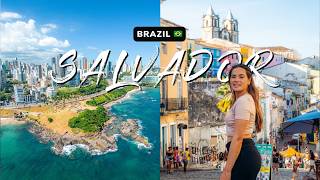
The “10 Best Places to Visit in SALVADOR 2026” video is the most efficient orientation tool in the set: it maps the main sites geographically and gives historical context for each, making it worth watching before anything else — useful as a skeleton, lighter on food specifics. The “Brazil as a Solo Black Woman Traveler” video does the opposite: it centres lived experience in the Pelourinho, covers accommodation trade-offs, and gives honest notes on traffic and neighbourhood logistics. Pair the two — the former for spatial orientation, the latter for ground-level judgement calls — and you arrive with a considerably more accurate picture than either provides alone. The “Best Places to Visit in Brazil” overview adds the Porto da Barra and food context that both longer videos assume you already know.
Beaches
All 7 beaches videos →


Cuisine
All 6 cuisine videos →
Itinerary
All 3 itinerary videos →
Traditional Culture
All 14 traditional culture videos →

Other cities in Brazil
Turn these videos into a Salvador day-by-day plan.
Plan my days in Salvador →