Sao Paulo: everything YouTube's best creators show you — sorted
31 videos across 4 topics, ranked by what's actually worth your time.
São Paulo is not a detour from Brazil — it is the country’s commercial and culinary engine, and treating it as a layover stop gets it wrong. No beaches, no carnival floats: what it offers instead is the most diverse dining scene in South America, a Japanese diaspora neighbourhood larger than anything outside Japan, and a fashion culture so dress-conscious that locals say if it is not in São Paulo, it is not in Brazil.

The city’s logic is best read through its neighbourhoods. Liberdade, the Japanese quarter, is the starting point — dense with Japanese restaurants, grocers, and a street market on Sundays. Importantly, it is also where Italian and Swedish restaurants sit within a few blocks of each other, a consequence of immigration waves that pulled workers from across Europe and Asia. A local resident interviewed in one video called the city’s cuisine “the best in the world” — a boast that is hard to argue after a single afternoon in the Mercado Municipal.
Jardins, the central leafy district, offers Oscar Freire street for high-end boutiques and the surrounding blocks for café culture and upscale dining — creators consistently call it the most walkable area. Ibirapuera Park is the city’s green centre: the Museum of Modern Art and the Afro-Brazil Museum both sit inside it. The Municipal Theatre, modelled on the Paris Opéra, schedules ballet, classical concerts, and opera and is a working cultural venue, not a photo stop.
March to May and October to November are the consensus windows — less rainfall, lower humidity, and none of the hot sweaty summers that run from December through February. The catch is that São Paulo’s altitude (around 760 metres) means winter mornings can be genuinely cold, so pack a layer even if you are arriving from a beach destination.
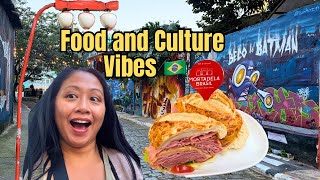
Food is the city’s dominant argument. The Mercado Municipal is the sensible first stop: the ground floor has pastel stalls and salgados, the upper floor carries restaurants serving feijoada and churrasco, and skipping the mortadela is consistently called a mistake by multiple creators. One food-vlog creator documented a multicourse afternoon — Italian, Japanese, and Brazilian dishes — that came to roughly USD 62, a price they noted would have exceeded USD 250 in Los Angeles. The Italian-Brazilian community sustains genuinely serious pizza: Foglia, cited for its wood-fired Margherita, draws direct comparisons to Italy from a creator who tested both. Beyond Italian, the International Fair at Liberdade surfaces vatapá and picanha alongside Japanese staples — treating it as a single-cuisine stop is the standard error to avoid.
Three to four days is the range creators converge on. The standard tourist instinct — beach at Copacabana, Cable Car at Sugarloaf — belongs to Rio; one creator flags this as the single most common category error visitors make. Skip beach-holiday thinking entirely.
The “10 FUN Things to Do” video is best used as a structural skeleton: it maps the city attraction by attraction, with Ibirapuera Park, the Mercado Municipal, and Liberdade in self-contained segments, but is light on street-level food detail. Pair it with “Discover São Paulo: The Ultimate Food and Culture Capital” — together they cover geography and dining logic in a way neither manages alone. Watch “Mistakes Tourists Make” first: it resets dress-code and safety expectations before the other two videos’ recommendations make full sense.
In the historic centre, one creator and their local guide advise arriving at the Mercado Municipal by taxi and waiting at the entrance when leaving, rather than walking surrounding streets with visible electronics — a narrow adjustment, not a reason to avoid the area.
Cuisine
All 13 cuisine videos →![Top 10 Best Things to do in São Paulo, Brazil [ São Paulo Travel Guide 2026 ]](https://img.youtube.com/vi/e3ORlzcGXD4/mqdefault.jpg)
Museums
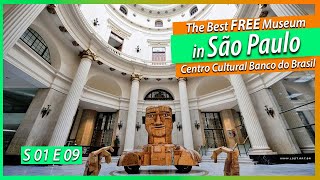
All 3 museums videos →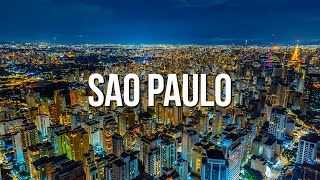
Nightlife
All 8 nightlife videos →
![🇧🇷 SAO PAULO 2:00 AM NIGHTLIFE DISTRICT BRAZIL 2026 [FULL TOUR]](https://img.youtube.com/vi/W_umR0YA0mY/mqdefault.jpg)
![Top 10 Best Things to do in São Paulo, Brazil [São Paulo Travel Guide 2026]](https://img.youtube.com/vi/WvfLrXj3E08/mqdefault.jpg)
Shopping
All 7 shopping videos →

Other cities in Brazil
Turn these videos into a Sao Paulo day-by-day plan.
Plan my days in Sao Paulo →