Amazon: everything YouTube's best creators show you — sorted
0 videos across 5 topics, ranked by what's actually worth your time.
The Peruvian Amazon in one frame
Peru’s slice of the rainforest is not a single destination but two very different doorways into the same biome, and the corpus is unusually clear on the trade-off. Iquitos in the north anchors river cruises down the Amazon proper; Puerto Maldonado in the east anchors jungle lodges along the Madre de Dios and Tambopata rivers [via Peru with Amazon cruise]. One creator who travels to the region annually frames it bluntly — three nights gives you two full days of excursions, four is materially better, anything shorter is wasted flights [via Peru with Amazon cruise]. The proposition is biological density, not sightseeing.

What’s here
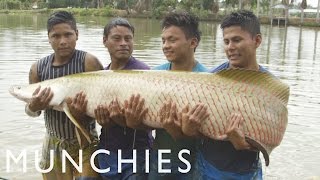
The northern gateway is Iquitos, a city of roughly 400,000 reachable only by plane or river, sitting on the upper Amazon. It is the launch point for multi-night cruise itineraries that push deep into the Pacaya-Samiria reserve and surrounding flooded forest, with 32-berth boats offering upper-deck cabins with floor-to-ceiling glass and three- or four-night options [via Peru with Amazon cruise]. The eastern gateway, Puerto Maldonado, sits in the Madre de Dios region and feeds the Tambopata National Reserve — this is lodge country, accessed by river boat from town, and the standard structure is guided jungle trekking in the morning, lodge time through the hot middle of the day, then community or oxbow-lake visits in the afternoon [via Peru in 7 Days]. Both gateways draw on the same broader Amazon culinary tradition, which chef Pedro Miguel Schiaffino describes as a cuisine shared across nine countries with common ingredients, seasoning, and techniques — paiche (the 400-pound river fish), exotic fruits, river snails, and worms [via Amazonian Aphrodisiacs and]. Note that the Amazon is the only one of Peru’s three macro-regions — coast, Andes, Amazon — that most itineraries treat as a bolt-on rather than a centrepiece, which is precisely why it tends to be the part travellers wish they had given more time to.
When to go and how to eat
The dry season runs roughly May to October and is the consensus window: lower river levels expose more trails, mosquito pressure drops, and lodge excursions run on a predictable schedule. The wet season (November to April) trades trail access for navigable creeks — boats reach forest interiors that are dry-season impossible, and wildlife congregates around remaining water. One creator who visits the rainforest annually still recommends packing for heat and humidity year-round and bringing serious repellent, because the basic climate does not change much between seasons [via Peru in 7 Days]. On food, the realistic expectation inside the jungle is lodge or cruise catering — Amazonian ingredients prepared by kitchens working with what the rivers and forest provide, rather than the restaurant scene you get in Lima or Cusco. The serious Amazonian cooking happens back in the capital at restaurants like Schiaffino’s Ãmaz, which treats the region as a coherent culinary territory rather than a curiosity [via Amazonian Aphrodisiacs and]. Inside the forest, expect freshwater fish, plantain, yuca, and regional fruits; outside it, the bigger ceviche-and-lomo-saltado canon takes over [via Visit Peru - What to Know]. Bottled water is the standard rule across Peru and applies with extra force in the jungle [via 10 Things To Know Before].
Pace and what to skip
Three nights is the working minimum, four is materially better, and anything shorter does not justify the flights in and the lodge transfer out [via Peru with Amazon cruise]. The harder question is cruise versus lodge. Cruises out of Iquitos move you through different stretches of river and reserve each day, which suits travellers who want breadth and a more comfortable base; Puerto Maldonado lodges root you in one ecosystem, which suits travellers who want depth and tighter contact with a single guide team [via Peru with Amazon cruise]. The combination move worth flagging is pairing the Schiaffino interview in “Amazonian Aphrodisiacs and 400-Pound Fish” with the practical itinerary in “Peru in 7 Days: A Food and Culture” — the first reframes the Amazon as a culinary region with nine-country roots, the second tells you how to actually slot it into a seven-day Peru trip without short-changing Cusco or Lima. Skip the half-day “Amazon experience” tacked onto Cusco-based tours; the genuine article requires the flight and the nights.
Museums
All 2 museums videos →
Nature
All 1 nature videos →
Lodges
All 0 lodges videos →Logistics
All 0 logistics videos →Wildlife
All 0 wildlife videos →Other cities in Peru
Turn these videos into a Amazon day-by-day plan.
Plan my days in Amazon →