Sacred Valley: everything YouTube's best creators show you — sorted
0 videos across 4 topics, ranked by what's actually worth your time.
Hook
The Sacred Valley is the part of a Peru trip that travellers consistently under-book and then wish they had given more time to. It sits roughly 20 to 30 kilometres north-west of Cusco, follows the Urubamba River through the Andes, and — critically — runs 600 metres lower in altitude than Cusco itself [via Peru: The Canyon Twice]. That single fact reorganises a sensible Peru itinerary: fly into Lima, transit through Cusco, and come straight here to acclimatise before Machu Picchu, rather than the reverse [via Visit Sacred Valley BEFORE].

What’s here
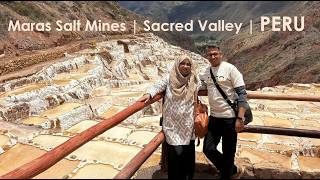
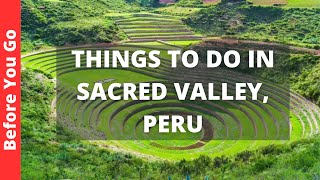
Four anchors do most of the work. Pisac sits at the eastern end of the valley, with a daily artisan market that swells on Tuesdays, Thursdays and Sundays when vendors from surrounding villages come down with textiles, pottery and produce — quality visibly better than Cusco, prices lower, and haggling expected from around half the asking price [via Peru: The Canyon Twice]. Above the town, terraced Inca ruins are reached by an hour-long climb and visited by a fraction of Machu Picchu’s crowds. Ollantaytambo sits at the western end and is the consensus base: cobblestone streets still laid out on the original Inca grid, a well-preserved fortress climbing the hillside above town, and — usefully — the train station for Machu Picchu [via The Epic Peru Journey]. Between them, Moray is a set of concentric circular terraces sunk into the plateau, each ring at a slightly different altitude to create microclimates a few degrees apart, used by the Incas as an open-air agricultural laboratory [via Peru: The Canyon Twice]. The Maras salt pans nearby are several thousand small evaporation ponds still worked by local families, the technique unchanged for around 500 years [via 20+ BEST Things to Do in Cusco]. The “Visit Sacred Valley BEFORE Machu Picchu” video is the single best primer here — it walks the case for basing in the valley and breaks down costs in detail.
When to go and how to eat
The dry season runs roughly May to September: cold nights, warm clear days, the green of the wet season faded but the trekking conditions at their best. The shoulder of April and October keeps the valley green without the heaviest rain. Bring layers — temperatures swing widely between morning, midday and dusk, even in dry months [via PERU One Country That Feels]. Inti Raymi, the festival of the sun, lands in late June and pulls the cultural centre of gravity towards Cusco for the week [via Peru Travel Itinerary]. On the food side, the valley is not Lima and you should not chase ceviche here — this is highland country and the dishes that earn their place are alpaca steak (lean, faintly gamey, on most menus), lomo saltado (a stir-fry of beef, onions, tomato and soy that reads as Chinese-Peruvian fusion), and ají de gallina, a shredded chicken in cream and ají amarillo [via Peruvian Food - What You Should Eat]. The standout sit-down is Mil Centro at Moray — the research kitchen of chef Virgilio Martínez, the lab arm of Central in Lima — which requires booking well in advance [via Peru in 7 Days]. For everything else, valley meals typically run 15 to 30 soles, a fraction of Cusco’s tourist-facing prices [via PERU One Country That Feels].
Pace and what to skip
The most common mistake is basing in Cusco and day-tripping in. Multiple creators converge on the opposite: base in Ollantaytambo for two to three nights, day-trip to Pisac, Moray and the salt pans from there, and visit Cusco on the way back from Machu Picchu rather than on the way in [via Visit Sacred Valley BEFORE; via Peru in 7 Days]. Pair the “Visit Sacred Valley BEFORE Machu Picchu” video with “Peru in 7 Days” before you book anything — the first makes the acclimatisation case; the second slots Moray, the salt pans and Ollantaytambo into a clean three-day rhythm that ends at the Machu Picchu train. Transport between sites is straightforward: shared colectivos run frequently for a few soles, or book a guided day tour from Cusco directly to Ollantaytambo to skip the back-and-forth. Skip the Sky Lodge glass-pod cliff hotel unless heights and a substantial budget both appeal — one creator flags it as distinctive but expensive, and it eats a night you could spend in the valley proper [via Sacred Valley Peru Travel Guide].
Museums
All 1 museums videos →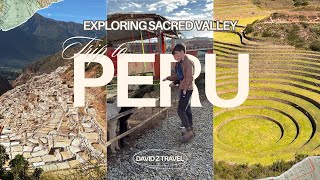
Itinerary
All 0 itinerary videos →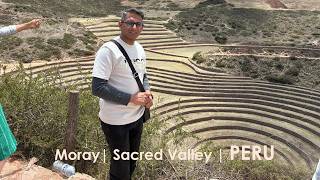

Markets
All 0 markets videos →Ruins
All 0 ruins videos →Other cities in Peru
Turn these videos into a Sacred Valley day-by-day plan.
Plan my days in Sacred Valley →