Lake Titicaca: everything YouTube's best creators show you — sorted
0 videos across 5 topics, ranked by what's actually worth your time.
The briefing
Lake Titicaca is the bit of Peru that does not look or sound like the rest of the country. At 3,827 metres, Puno is one of the highest cities you can fly into on a standard itinerary, and the lake itself — straddling the Bolivian border, covering more than 40 inhabited islands — is the highest navigable body of water in the world [via Top 10 Best]. The pitch is not scenery alone. It is that the communities on the lake speak Aymara rather than Quechua, descend from cultures the Incas never absorbed, and run a daily economy on reeds, weaving and trout. Most Peru trips treat it as an add-on; treat it as a slowdown instead.

What’s here
The base is Puno — a port town that most creators agree is not the point. One walks the corpus and finds the same line repeated in different words: the city itself is unremarkable, but it is the only sensible launchpad for the islands [via Amazing Places to]. From Puno’s harbour, boats fan out to three distinct stops that together compose the trip. The Uros floating islands sit closest, perhaps half an hour out. They are entirely man-made from totora reeds, continuously rebuilt as the lower layers rot, with houses, boats and even some of the food itself drawn from the same plant [via VIP Birthday trip]. Taquile Island, further into the lake, is a real island with a striking gender inversion in its labour: the women farm the terraced fields while the men weave the textiles the island is known for [via VIP Birthday trip]. Amantani, often paired with Taquile on two-day circuits, is where homestays happen — sleeping in a village house and eating with a family, rather than returning to a Puno hotel. The standard sequencing is Uros for the engineering shock, Taquile or Amantani for the cultural depth, with the rougher second stop justifying the first one’s brevity. A small necropolis on the way out — visited en route back to Juliaca airport — rounds out the archaeological side [via VIP Birthday trip].
When to go and how to eat
The dry season runs roughly May through September and is what every creator who logs weather converges on. Skies are clear, the lake’s surface holds the deep blue it is famous for, but nights at this altitude drop sharply — bring layers regardless of season. The harder constraint is altitude itself. Puno sits higher than Cusco, and arriving direct from sea level invites trouble; the standard advice across the corpus is to acclimatise in Cusco or the Sacred Valley first and treat Titicaca as the back end of an itinerary rather than the front [via 10 Things To]. Several creators recommend the PeruRail journey from Cusco to Puno as the connector — eight to nine hours, three days a week, with an open-air observation carriage and a single market stop, framed less as transport and more as a deliberate reset before the lake [via VIP Birthday trip].
Food on the lake is narrower than in Lima or Arequipa, and that is the point. Trout from Titicaca is the standout protein — one creator singles it out as genuinely excellent for fish-eaters this far inland [via Visit Peru - The]. Quinoa and potato dishes anchor most plates, often served at homestays as a soup-then-main rhythm cooked over a small kitchen fire. On the islands themselves, expect simple, vegetable-forward meals; the indulgent dining lives back in Puno. Standard Peruvian water precautions apply harder here than at altitude: bottled only, and digestive remedies in the bag.
Pace and what to skip
Two nights is the consensus shape. Day one is the open-water transit to the Uros and onward to either Taquile or Amantani; day two is the slower cultural element — the homestay, weaving demonstrations, the walk to the village’s high point at sunset. A pure day trip from Puno hits Uros and turns around, which the corpus treats as the weakest version of the visit: the floating islands without the deeper-lake communities are essentially a photo stop. The pairing to make is straightforward — watch the “HOW TO TRAVEL PERU” overview first to understand why the islands sit at the cultural top of any Peru trip [via HOW TO TRAVEL], then watch the “VIP Birthday trip to Peru 2026” itinerary to see how the two-night Cusco-to-Puno-to-Juliaca structure actually sequences. Together they give you the why and the how without overlap. Skip the day-trip-from-Cusco temptation, skip the Bolivia border crossing unless you are actually continuing into Bolivia, and weigh the homestay seriously — it is the part most creators flag as the trip’s emotional centre.
Itinerary
All 1 itinerary videos →
Museums
All 1 museums videos →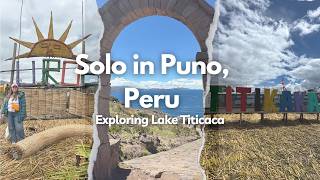
Day Trips
All 0 day trips videos →
Floating Islands
All 0 floating islands videos →Homestays
All 0 homestays videos →Other cities in Peru
Turn these videos into a Lake Titicaca day-by-day plan.
Plan my days in Lake Titicaca →