Fukuoka: everything YouTube's best creators show you — sorted
20 videos across 4 topics, ranked by what's actually worth your time.
Fukuoka is the argument for ending a Japan itinerary on Kyushu rather than doubling back through Osaka. Most travellers treat it as a transit point — fly in, catch the shinkansen north — which is a miscalculation. The city’s yatai stall culture and its sub-290-yen ramen shops give a more unmediated version of everyday Japanese food than anything along the golden route.
Fukuoka Airport sits practically inside the city, a logistical advantage that creators consistently note when advising on Kyushu itineraries: fly in here first, then use the city as a base for travel south to Beppu or along the coast.
The city’s food geography anchors around the yatai — open-air stalls lining the Nakasu riverbank — which operate in the evening. These are not tourist recreations; the format is genuinely local, with most stalls seating eight to twelve people at a communal bench rather than a restaurant table.
The Hakata neighbourhood gives the city its other identity: the ramen style that carries the city’s name. Hakata ramen is not a single standardised product — the defining variable is noodle firmness, and the local recommendation is body kata, the extra-firm specification that holds its texture in the tonkotsu broth.
The KKU_QZTv_E4 video is the strongest single resource for understanding Hakata ramen in practice: it films the ticket-machine ordering process at a small local shop, walks through the firmness choice with a local recommendation, and quotes the price at 290 Japanese yen. It is narrowly focused on ramen and does not cover the yatai circuit or broader sightseeing.
The consensus across the corpus is that Fukuoka sits comfortably in a winter Japan itinerary, partly because the yatai stalls are particularly well suited to cold evenings. The city is on Kyushu, Japan’s south-westernmost main island, which means it runs roughly two to three degrees warmer than Tokyo in December and January — cold enough for the ramen shops to be full, mild enough that outdoor stall eating is not punishing.
The food story in Fukuoka is narrower than in Osaka or Tokyo, and that is the point. Tonkotsu ramen, the pork-bone broth style that originated in the Hakata area, dominates the small-shop scene. The yatai stalls, meanwhile, run a different menu — grilled skewers, oden, yakitori — and they are the correct venue for the social side of eating here rather than for the ramen specifically. The practical advice that emerges from the videos is to treat these as separate circuits on separate evenings rather than combining them into a single night out.
Note that the chunks do not document a festival window specific to Fukuoka; the timing recommendation is driven by weather and ramen-shop logic rather than by a calendar event.
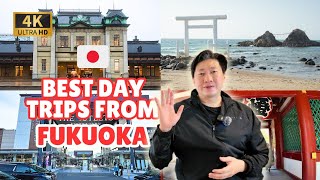
Two days is the floor for doing the city justice; three is the consensus recommendation when Fukuoka is a Kyushu base rather than a single destination. The airport-inside-the-city advantage means you lose no half-day to transfers.
Skip the chain ramen shops near the airport and the tourist-facing stalls around Canal City: both are aimed at visitors who do not know what they are looking for. The local-shop circuit in Hakata — the 290-yen category — is the better use of a meal slot, even if it requires a short metro ride.
For a complete picture of the city’s food logic, pair KKU_QZTv_E4 with the “Ultimate Japan Travel Itinerary” video. The former gives you the ramen mechanic in close-up; the latter places Fukuoka inside a Kyushu arc and frames the yatai culture in a multi-city context. Together they cover both the granular (how to order, what it costs) and the strategic (how Fukuoka fits a two-week Japan plan).

Cuisine
All 3 cuisine videos →

Day Trips
All 4 day trips videos →
Nightlife
All 4 nightlife videos →


Street Food
All 9 street food videos →



Other cities in Japan
Turn these videos into a Fukuoka day-by-day plan.
Plan my days in Fukuoka →