Nara: everything YouTube's best creators show you — sorted
23 videos across 3 topics, ranked by what's actually worth your time.
Nara’s proposition is simple and impossible to replicate elsewhere: a UNESCO-listed temple complex containing the world’s largest bronze statue, surrounded by a public park where over 1,000 sika deer roam freely and approach strangers for food. Most travellers arrive from Osaka or Kyoto for a single day, and that is the right call — Nara rewards four to six hours of concentrated attention rather than an overnight stay.

The gravitational centre of Nara is Todai-ji, the great temple housing the Nara Daibutsu — a 15-metre bronze Buddha that has sat in place since 752 AD. Entry costs around 500 yen and the scale of the hall stops most visitors before they reach the statue. Importantly, the interior detail repays slow looking: one wooden pillar near the rear has a square hole at its base, with a long-standing tradition that squeezing through guarantees enlightenment in a future life — worth attempting if the queue is short.
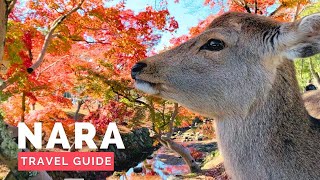
Outside the temple complex, the deer are not background scenery — they are the second attraction. Vendors throughout Nara Park sell deer crackers, and the animals have learned to bow before accepting them. The formal bow is the detail creators converge on; most describe being surrounded and pestered rather than gently approached, so treat your snacks as crowd-control tools rather than photo props.
South of Todai-ji, Kasuga Taisha shrine rounds out the main circuit. For a different vantage point, the hike up Wakakusa-yama to the lower viewpoint takes around 20 minutes and is largely shaded; the panoramic view of the city and surrounding region makes it worth the detour if time allows.
Spring and autumn are the clear consensus windows. Cherry blossoms arrive in the park in spring, and the maples deliver strong autumn colour in October and November. The catch with both seasons is that Nara is typically a side-trip on larger Kansai itineraries, so peak-season crowd pressure is driven by the same travellers flooding Kyoto at the same time — plan to arrive early and leave before mid-afternoon.
Nara’s food identity is narrow but specific. Mochi is the defining local product: one small mochi shop near Todai-ji runs a mochi-pounding demonstration before selling freshly made pieces. Multiple creators list this as the one food priority in Nara rather than a general market browse. The complementary move is a matcha set with wagashi — traditional confections — at one of the tea houses flanking the temple complex; the bitter-sweet pairing and the view of deer through the window is a detail more than one creator singles out as the ideal mid-visit pause. There is no equivalent in Nara of Osaka’s density of food options, so arrive with lunch expectations calibrated accordingly.
One day is enough for Nara, and the standard routing — Todai-ji, Nara Park deer, Kasuga Taisha, optional Wakakusa-yama hike — holds up well across multiple itineraries. Skip the overnight stay unless Nara is specifically your base for wider Yamato region exploration; the town quiets significantly after the day-trip crowds leave, but the restaurant and bar scene does not compensate for the earlier energy.
The “Why You NEED To Experience” video is the most useful single source for Nara specifically — it covers Todai-ji, the Wakakusa-yama hike, and the logistics of moving between sites within a half-day window, making it the right foundation watch before arrival. Pair it with the “How to Spend 14 Perfect” video, which supplies the inside-the-temple detail (the pillar hole, the matcha tea house stop) that the broader itinerary video glosses over — together they cover both the logistical skeleton and the slower, observational layer that makes Todai-ji worth more than a single photograph.

Nature
All 13 nature videos →
![Top 10 Best Things to do in Nara, Japan [Nara Travel Guide 2026]](https://img.youtube.com/vi/4tDWpAugz0Y/mqdefault.jpg)

Temples
All 4 temples videos →


Traditional Culture
All 6 traditional culture videos →
Other cities in Japan
Turn these videos into a Nara day-by-day plan.
Plan my days in Nara →