Madrid: everything YouTube's best creators show you — sorted
28 videos across 11 topics, ranked by what's actually worth your time.
The case for Madrid is not the obvious one. It is not a particularly beautiful city by the standards of Seville or Salamanca; it lacks a river worth mentioning and its central boulevards were designed for imperial grandeur rather than human-scale walking. What Madrid has instead is concentration. The Prado, the Thyssen-Bornemisza, and the Reina Sofía sit within a fifteen-minute walk of each other, constituting one of the three or four greatest museum triangles in the world. The Retiro park is 350 acres of managed green space ten minutes from any hotel in the centre. The food scene — particularly the traditional tabernas of La Latina, the market culture of San Miguel and San Antón, and the Michelin ecosystem spreading south into Lavapiés — is more interesting than the city’s tourist reputation suggests. And the nightlife, which starts properly after midnight and runs until 6 a.m. on weekends, is not a cliché: Madrid’s clubs and cocktail bars are genuinely good, and the city’s attitude toward late hours is structural, not performative. Spain divides into regions; Madrid is the one that belongs to none of them and all of them.

May and October are the consensus best months. May brings temperatures of 18–24°C, the city’s parks in full bloom, and the San Isidro festival in the second week of the month — one of the oldest bullfighting seasons in the world, but also street parties, concerts, and city-wide events that make the city feel alive in a specific way. October delivers clear skies, cooler walking temperatures, and the summer crowds largely gone. Avoid August if your visit is flexible: the city empties, many neighbourhood restaurants close, and temperatures on the central plateau regularly exceed 38°C. January and February are cold — properly cold, with frost — but the museums are quieter, the queues manageable, and the city runs at a pace that rewards slow exploration.
A two-day Madrid itinerary with teeth runs as follows. Day one morning: the Prado, arriving at opening (10 a.m.) and spending three hours maximum — the building contains more than you can absorb in a single visit, so commit to two or three rooms and leave something for a second trip. Walk south through the Retiro park for lunch. Afternoon: the Reina Sofía for Picasso’s Guernica, which takes around ten minutes to see properly and cannot be photographed. The surrounding collection of 20th-century Spanish art is underrated. Evening: La Latina neighbourhood for vermouth at one of the traditional bodegas — El Tempranillo on Calle de la Cava Baja is the frequently cited reference point — followed by a long dinner. Day two: the Palacio Real (biggest royal palace in Western Europe by floor area, often overlooked) in the morning, then the Mercado de San Miguel for a grazing lunch, then the Lavapiés neighbourhood in the afternoon for the alternative gallery scene and one of the city’s best coffee shops. Rooftop bar at sunset — the Círculo de Bellas Artes rooftop is the one most consistently mentioned in the corpus.
Madrid’s food identity is often confused with Spanish food identity, and it is worth separating them. Cocido madrileño — a three-course chickpea stew served in sequence — is the city’s signature dish: broth first, then chickpeas and vegetables, then the meat. It is heavy, cheap, and best eaten as a Saturday lunch. Bocadillo de calamares, the fried squid sandwich sold for around €3–4 from the bars around Plaza Mayor, is the correct street food. Jamón ibérico de bellota — acorn-fed Ibérian cured ham — is available everywhere but ranges from mediocre to extraordinary; the correct approach is to go to a specialist jamón bar (many in the Malasaña and Chueca neighbourhoods) and pay for a plate of the real thing rather than picking up sliced supermarket product. The menú del día across La Latina and Lavapiés runs €12–15 and is reliably the best-value eating in any given day.
Neighbourhoods worth staying in: Sol/Gran Vía for first-timers who want to be central and walk everywhere; La Latina for the traditional Madrid atmosphere and the Sunday Rastro flea market; Malasaña for independent restaurants, vintage shops, and the bohemian energy that makes the city feel young; Chueca for the LGBTQ+ neighbourhood, excellent cocktail bars, and proximity to Chueca metro. Budget hotel bands: mid-range in La Latina or Malasaña runs €80–130 per night. The Gran Vía corridor has business hotels at €120–180. A genuinely good boutique hotel in Chueca or Malasaña can be found at €90–140 if booked two to three weeks ahead.
Tourist traps worth naming: the restaurants immediately around Plaza Mayor are expensive for what they deliver; eat one street back and pay half the price. The Bernabéu stadium tour is excellent if you care about football and expensive if you do not. Avoid the hop-on hop-off bus as a first-day orientation tool — the city is walkable in its core, and the bus covers it worse than the metro does. The single most consistent practical note across the corpus: Madrid’s museums are closed on Mondays. The Prado, Reina Sofía, and Thyssen all shut Monday — plan around this or lose a day.
Budget Tips
All 2 budget tips videos →

Day Trips
All 7 day trips videos →

Hidden Gems
All 2 hidden gems videos →
Itinerary
All 19 itinerary videos →

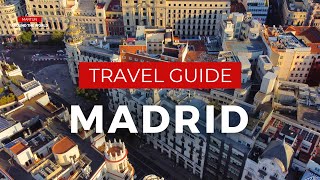
![Top 10 Best Things to do in Madrid, Spain [ Madrid Travel Guide 4k 2026 ]](https://img.youtube.com/vi/p8Dz42JyNRE/mqdefault.jpg)
Shopping
All 1 shopping videos →
Architecture
All 0 architecture videos →
Art & Museums
All 0 art & museums videos →

Cuisine
All 0 cuisine videos →
History
All 0 history videos →
Markets
All 0 markets videos →Nightlife
All 0 nightlife videos →

Other cities in Spain
Turn these videos into a Madrid day-by-day plan.
Plan my days in Madrid →